

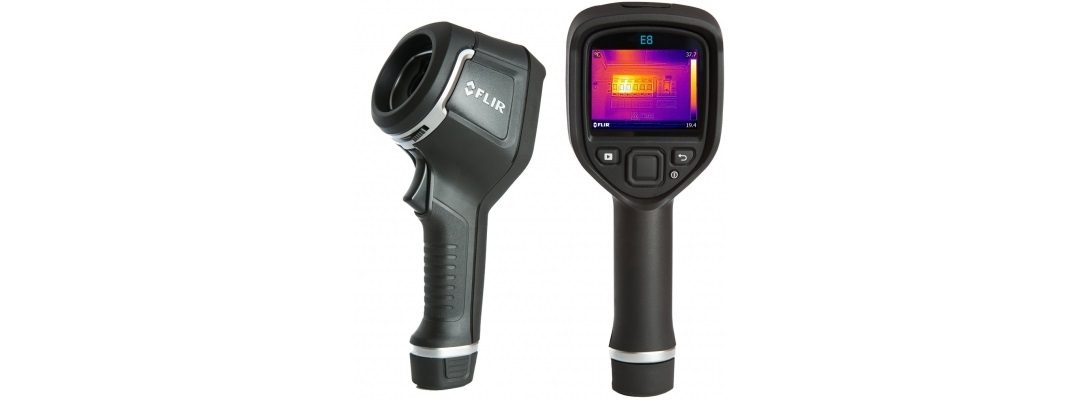
On 1st October 2013, FLIR launched a brand new range of cameras and a redesigned version of their existing Exx series. We look at the new models available and discuss how thermal imaging is moving forward with these innovative thermal cameras.
The all new FLIR Ex Range
Lightweight, compact and designed for the cost-conscious user. The FLIR Ex range of point-and-shoot cameras will really take the market by storm. Offering a choice of four models, with differing resolution and sensitivity, there really is a camera to suit all applications.


The images above are a representation of the MSX enhancement, taken with a 640 x 480 resolution thermal camera.
Another great feature of these cameras is the 45° wide angle lens, which makes it great for looking at larger switch panels or buildings, or when working in confined spaces.
The user menu is very intuitive and you’ll easily find your way around the various parameters and settings that are available. The user controls have also been well thought out, with a large button in the middle for selecting options or navigating around the menus.
Because this range has been designed as a budget camera, the features and settings are limited, compared to the more expensive models. Firstly the cameras are fixed focus, which means you have no control over focussing, much like many mobile phone cameras, although for most basic applications this probably won’t be too much of an issue.
Secondly, the Ex series do not have the option to thermally tune the image in-camera. Thermal tuning is adjusting the temperature level and span in order to highlight specific problem areas. Whilst this function is available in the software, it is often a useful tool to have when in the field.
Finally the built-in digital camera is only 0.3 megapixel, which doesn’t render great quality digital images, although on the plus side it does have an automatic correction for low light applications, so you will still see reasonable detail when used in poorly lit areas.
A real bonus of the FLIR cameras is the ability to keep the firmware up-to-date from the software. Any future improvements within the model can be easily upgraded from your own PC and the software will give you the option to check for updates when you connect your camera and notify you of any that are available.
What Applications Are They Suitable For?
So, where do the Ex series cameras fit in today’s marketplace? We see them being used a lot for general electrical, industrial and basic building checks. With the addition of MSX, it makes tracing the heat sources a lot easier than before. For larger contractors out there, where you have a number of engineers to carry out the initial checks, the new Ex range gives you a low cost option to do so.
In terms of buildings, what are you likely to see? Typically, basic faults such as thermal bridges and moisture ingress should be easily detected, however with the very low end FLIR E4 and FLIR E5 models it may be a bit difficult.
How Easy Are They to Use?
To use, the Ex cameras are quick and easy. The software loads faster than previous camera models and the trigger on the front captures an MSX and digital version of each image for download to a PC. Once in the FLIR Tools software, you can then switch between various image modes including full thermal, fusion, IR blending and more.
The Ex series thermal cameras feature a built-in memory, which will hold up to 200 images and is more than enough for a general survey.
What’s in the Box?
Each camera is supplied with 2 Li-Ion batteries, desktop charger, FLIR Tools software, calibration certificate and a hard carry case. In addition, the camera is backed with a 2 year warranty and an additional 10 year warranty on the detector.
Available Models & Pricing
Prices in this range start at £796, making this the lowest priced thermal imaging camera on the market and representing very good value for money. Whilst we wouldn’t recommend these cameras for those offering a consultancy service, they will definitely suit those who need to carry out thermal surveys in conjunction with a regular inspection and maintenance program.
The four models available in this range are:
| FLIR E4 | FLIR E5 | FLIR E6 | FLIR E8 |
| £796.00 | £1,196.00 | £1,996.00 | £4,796.00 |
| 80 x 60 pixel resolution | 120 x 90 pixel resolution | 160 x 120 pixel resolution | 320 x 240 pixel resolution |
| 0.15°C thermal sensitivity | 0.10°C thermal sensitivity | 0.06°C thermal sensitivity | 0.06°C thermal sensitivity |
| Center Spot | Center Spot, Min / Max Temperature Markers | Center Spot, Max / Min Temperature Markers, Above and Below Color Alarms. |
Center Spot, Max / Min Temperature Markers, Above and Below Color Alarms. |
Introducing the Exx Mk II Models
The FLIR E40, E50 and E60, including bx model thermal cameras have been around for a while and have a proven track record of reliability and functionality.
This range has undergone a redesign to improve the features, menu navigation controls and the user interface, resulting in the Mk II version of this camera.

Secondly, the navigation controls have been greatly improved, cutting the number of buttons and integrating a single navigation button in the center of the back panel.
Another unique feature that FLIR have added to the Exx series is auto-image orientation. If you turn the camera 90°, the image on screen will rotate accordingly, giving you a true portrait image. This image will also render as portrait in the software.

I Have an Old Exx Camera, Can I Upgrade to the Mk II Model?
Because the firmware and camera controls for the Mk II models have all been changed an upgrade is not possible.
We don’t see this as a downside, because existing users of the Exx Mk I cameras still have the key measurement functions of the new range.
Why Buy a FLIR Exx Series?
This is a good question. With the launch of the lower range Ex cameras, what do you get for your money if you choose to move to the Exx range?
First you have a number of features that make using the camera easier, such as the touch screen, which enables easy movement and setup of measurement tools.
Then there is the ability to thermally tune your image in the field, thus allowing you to locate faults that may be masked in the standard auto mode, these could be faults that are just starting to occur and may show as a very small difference when in automatic mode. With thermal tuning you can adjust the temperature settings to highlight potential problem areas that could have been missed otherwise.
The Exx series also features a higher quality digital camera, better thermal sensitivity, the ability to change to a telephoto or wide angle lens, manual focussing and in-camera video recording. The Exx is ideal for those who are offering thermography as a service, or who want to produce high quality thermal and digital images for their reports.
There are two types of camera for each model in the range. The standard models have a high temperature range, up to 650°C, whereas the bx models are designed for building surveys and feature the dewpoint and insulation limit temperature alarms and a better thermal sensitivity.
How do I Decide Which Camera to Buy?
This is a question we often get asked. There is a camera to suit every budget, but you should consider carefully the resolution you want first, as this cannot be changed without buying a new camera.
Think about the application you have. Are you carrying out surveys in-house or on behalf of your customers? A lower resolution camera works well in many basic applications, however if your client is used to seeing reports with a 320 x 240 pixel camera, they may ask questions if they see reports produced with a lower resolution. Typically a low resolution camera will indicate there is a problem, whereas a higher resolution camera will give you a better indication as to the type of problem.
If you are unsure as to what camera to buy, there are free application guides available that can help you through the decision making process. In addition, our technical experts are on hand to discuss your requirements and ensure you get the right equipment, call us on 01923 442244 to find out more.
Alternatively, you could attend a one-day training course where different cameras are made available in order for you to make a more informed decision as to which model would best suit your application.
Is Training Necessary?
The short answer is yes! Whilst the camera controls and menus have been simplified, it is still very easy to make the camera lie and misinterpret an image. Many people wrongly believe that the temperature measurement given by the camera is correct, however the truth is that this temperature measurement is based on other settings within the camera. Change the settings and the temperature readings will change also.
By attending a thermography training course, you will fully understand how to use the camera, set up for a survey, get correct temperature readings and how to analyse the thermal images correctly to draw an accurate conclusion. In addition you’ll understand how the camera sees different materials and avoid making many of the common mistakes made by the untrained user.
At Instrotech, we offer a series of one day training courses, that are ITC (Infrared Training Center) approved. These courses ensure you have the key knowledge and understanding to carry out thermal surveys correctly. Please visit our training page to find out more.


