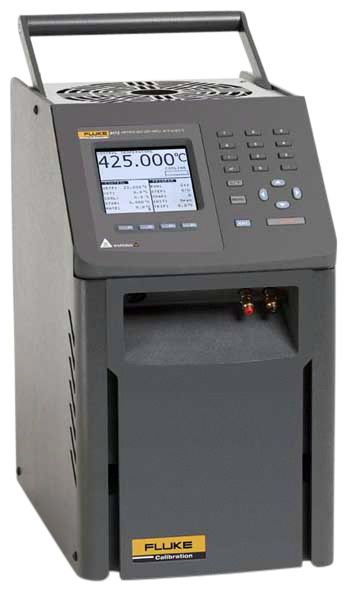
A leap forward in field temperature calibration, the Fluke 9172 features a temperature range of 35°C to 425°C, a calibrated display that is accurate to +/- 0.2°C (at 425°C) and stability between +/- 0.005°C to +/- 0.01°C, depending on the temperature. In addition, the 203mm well significantly reduces stem conduction errors at high temperatures.
A large LCD display will simultaneously show block temperature, built-in reference, cutout temperature, stability criteria and ramp rate. An RS-232 interface allows connection to the Interface-IT software (included) or other Fluke calibration software, such as MET/TEMP II. There are four different pre-programmed calibration tasks and up to eight temperature set points available with ramp and soak times between each test. Any one of six inserts can be ordered with the 9172 to cater for most probe types and the inserts are also interchangeable.
Fluke Metrology wells give you the performance of a calibration bath, with the portability and accuracy of a dry-well. According to document EA-10/13 (European Metrology Community) there are six key components that are critical when it comes to the performance of an industrial heat source, these include hysteresis, radial and axial uniformity, impact from loading, calibrated display accuracy and stability. Fluke Metrology wells incorporate all these features, but also add another, the inclusion of a built-in reference thermometer input.
Reference Thermometry Built-In
By incorporating proprietary Tweener circuitry directly in a heat source, you can read thermometer probes accurately via the built-in reference input, which accepts 100, 25 & 10Ω PRTs. This input is compatible with all PRTs sold by Fluke and connects to the well via a 5 pin DIN connector.
Stability
Stability of the Fluke 9172 is temperature dependent, however it ranges from 0.005°C at 100°C to 0.01°C to 425°C. Fluke heat sources are among the most stable in the world, with better stability only being found in fluid baths and primary fixed point devices.
Calibrated Display Accuracy
Metrology wells are designed to minimise the impact that temperature gradients, loading and hysteresis have when calibrating the display. As such you are guaranteed consistent and repeatable results, accuracy can be further improved by ordering your Metrology well with the built-in reference input.
Axial Uniformity
As suggested in EA-10/13, dry wells should have a 40mm zone of maximum temperature homogeneity. Dual-zone control and unique electronics are combined to provide homogeneous zones over 60mm.
Radial Uniformity
Defined as the difference between two wells, poorly designed heat sources will can have differences that are very large. With the Fluke 9172, the specification is defined as the largest temperature difference between the vertically homogeneous zones of any two wells.
Immersion Depth
The depth of the well you are using to test is important. The Fluke 9172 has a well depth of 203mm, which helps in eliminating axial gradients and loading effects. In addition it will address the unique characterisations of the probe under test, such as the sensor size and location, width and thermal mass.
There are several models in the range as listed below. Prices may vary depending on the model ordered, please contact us on 01923 442244 for a formal quotation:
- Fluke 9172-A-256: with Insert A
- Fluke 9172-A-R-256L with Insert A & Built-In Reference
- Fluke 9172-B-256: with Insert B
- Fluke 9172-B-R-256: with Insert B & Built-In Reference
- Fluke 9172-C-256: with Insert C
- Fluke 9172-C-R-256: with Insert C & Built-In Reference
- Fluke 9172-D-256: with Insert D
- Fluke 9172-D-R-256: with Insert D & Built-In Reference
- Fluke 9172-DW-256: No Insert
- Fluke 9172-DW-R-256: No Insert & Built-In Reference
- Fluke 9172-E-256:with Insert E
- Fluke 9172-E-R-256: with Insert E & Built-In Reference
- Fluke 9172-F-256: with Insert F
- Fluke 9172-F-R-256: with Insert F & Built-In Reference