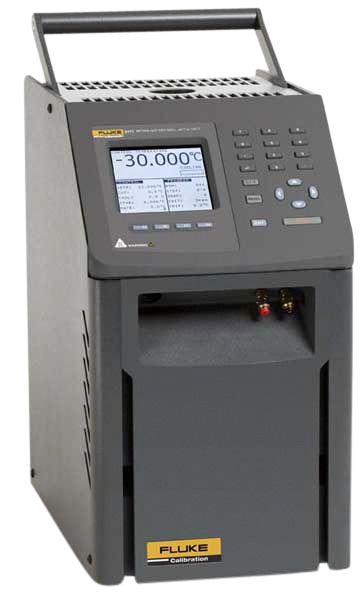
The Fluke 9171 dry-well calibrator gives you the performace of a calibration bath, with the portability and accuracy of a dry-well. In addition you can also purchase this model with a built-in reference thermometer for greater accuracy.
The 9171 has a temperature range of -30°C to 155°C with a well depth of 203mm and stability across the full range of +/- 0.005°C. The display accuracy is calibrated to +/- 0.1°C, making this an ideal for a broad range of applications.
Standard features include a large LCD display, numeric keypad and intuitive on-screen menus. The display will simultaneously show the temperature of the block, the reference temperature, stability criteria, ramp rate and built-in reference temperature.
An RS-232 port allows for connection to a PC for use with the Interface-IT software (supplied) or other Fluke calibration software. If using the well ins standalone mode, there are up to four pre-programmed calibration tasks which allow up to a maximum of 8 temperature set points with ramp and soak times between each.
An automated switch test protocol zeroes in on the dead band for thermal switches.
There are 6 critical components regarding performance of an industrial heat source, as explained in document EA-10/13 (European Metrology Community). These components are calibrated display accuracy, hysteresis, loading, stability, radial and axial uniformity. The Fluke 9171 adds a seventh, in the form of a built-in legitimate reference thermometer.
Reference Thermometer Built-In
On the -R- models, there is a built-in reference thermometer which uses the Fluke propriety Tweener measurement circuitry. The input accepts 100, 25 and 10Ω PRTs, reading thermometer probes accurately from +/- 0.006°C at 0°C to +/- 0.027°C at 661°C and is compatible with every PRT sold by Fluke.
Display Accuracy
Fluke Metrology Wells feature a more accurate display, as the factors that can affect the readouts (hysteresis, temperature gradients and loading effects) have all been minimised by using traceable and accredited PRTs with the proprietary Tweener electronics which ensure consistent and repeatable accuracy.
Stability
These low temperature wells are stable to +/- 0.005°C over their full range and are among the most stable heat sources in the world.
Axial Uniformity
EA-10/13 suggests all dry-wells should include an area of maximum homogeneity that extends for 40mm. With the Fluke Metrology wells, unique electronics, dual-zone control and deeper wells combine to provide a homogeneous zone over 60mm.
Radial Uniformity
This is the difference in the temperature between two wells. The design of the Fluke 9171 means you get consistency between them, with the specification being defined as the largest temperature difference between the vertical homogeneous zones of any two wells.
Immersion Depth
This is a key factor when it comes to temperature calibration. It helps to minimise the effects of loading and axial gradients, whilst addressing the unique characteristics of the probe under test.
There are several models in the range as listed below. Prices may vary depending on the model ordered, please contact us on 01923 442244 for a formal quotation:
- Fluke 9171-A-256: with Insert A
- Fluke 9171-A-R-256L with Insert A & Built-In Reference
- Fluke 9171-B-256: with Insert B
- Fluke 9171-B-R-256: with Insert B & Built-In Reference
- Fluke 9171-C-256: with Insert C
- Fluke 9171-C-R-256: with Insert C & Built-In Reference
- Fluke 9171-D-256: with Insert D
- Fluke 9171-D-R-256: with Insert D & Built-In Reference
- Fluke 9171-DW-256: No Insert
- Fluke 9171-DW-R-256: No Insert & Built-In Reference
- Fluke 9171-E-256:with Insert E
- Fluke 9171-E-R-256: with Insert E & Built-In Reference
- Fluke 9171-F-256: with Insert F
- Fluke 9171-F-R-256: with Insert F & Built-In Reference