

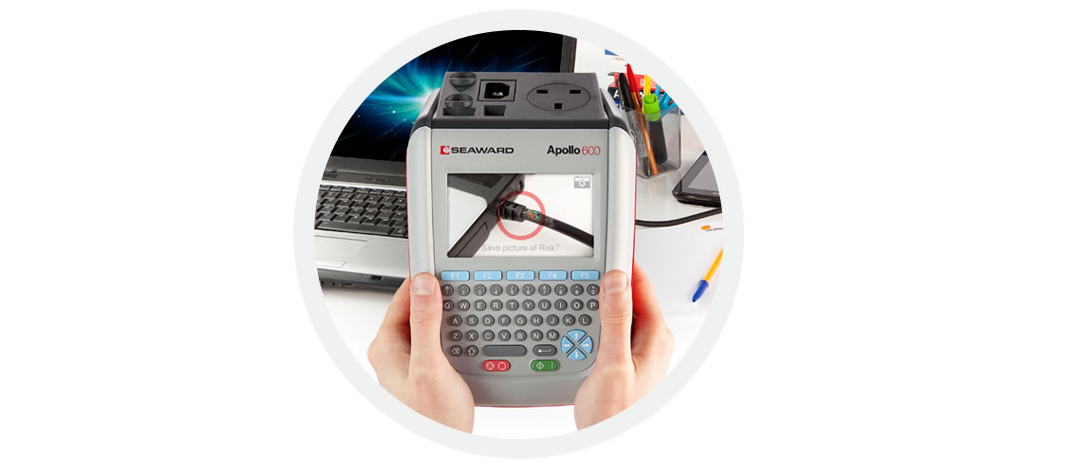
Well, at last we’ve got our hands on the final production version of this ground breaking new product. Not a prototype, not a demo version, but the real thing.

We’ll come onto its PAT test capabilities later, but there are two key things that make it stand out.
The first is the integral camera that allows photos to be taken and attached to the reference number of the appliance being tested, or more generally of the risk being assessed. This can be used to show both the problem and the solution with photos taken before and after fixing a problem.
The second thing is the risk based approach. The embedded software allows you to enter risk assessments, calculating risk scores and allowing corrective action to be planned and documented.
Any risk e.g. a loose carpet tile, can be photographed, assessed and the required action noted and followed up.

The unit is easily upgradeable via the USB slot and the upgrade process is much faster and simpler than for earlier Seaward products.
Ergonomically the unit ticks all the boxes. It’s an acceptable weight (1.5kg) and feels comfortable in the hands with good balance. The qwerty keyboard is responsive and easy to use.
Much thought has clearly gone into the user interface, to make operation of the menus and options consistent and easy to navigate (apparently much of the delay in finally getting the Apollo to market was down to fine tuning the user interface to simplify its use as much as possible).
So, while many people will see the potential of the Apollo as a risk management tool, it must first earn its keep as a PAT tester.
How does it stack up?
It has pretty much every feature you could want in a PAT. The only two omissions are a flash test, which is generally only used on some appliances in a repair environment, and a high current 25 Amp or hard earth bond test.
As the unit can be powered from either rechargeable batteries or the mains, a 25 Amp test in mains mode was a possibility but doubtless the impact on weight, cost and size rules it out. It’s not a significant loss as most users are comfortable with a 200mA earth bond test.
It includes all the basic tests with default, but user definable, pass limits including the earth bond test mentioned above, 250v and 500v insulation tests and the ability to test IEC leads. The 250V test is particularly useful for testing items with surge protection. It’s also the ultimate defence against IT managers who are terrified of their equipment being exposed to 500V insulation tests.
In addition it can measure load current under power, protective conductor current and touch current. When used in battery mode, an alternative leakage current is available although, as in all PATs, this can give misleading readings on some appliances.
Finally, the Apollo 600 completes its range of tests with a basic socket test and an RCD test, which has built-in protection to ensure RCDs on the circuit are not tripped.

Standard accessories are generous with a calibration checkbox for regular quick checks to ensure basic functionality remains within specification.
The need to test fixed appliances is addressed with the re-introduction of point to point testing, using the two leads supplied. This feature was available in some older PAT testers and is also very useful for fault finding. It should be emphasised though that persons not trained and competent in safe isolation procedures and with detailed knowledge of the wiring circuits involved should not attempt to test fixed appliances.
Included with the standard model are adaptors for testing extension leads and 110v appliances, a USB download cable, carry case, quick start guide and a mains lead.
Optional accessories, which can really speed up testing and re-testing, are Bluetooth barcode scanner and printers. Also available is a 3 phase adaptor and a free trial of PATGuard3 software.
PATGuard 3 is another innovation in the PAT market. The software can be bought on a subscription basis and as long as the subscription is kept up to date, improvement, additions and the inevitable bug fixes are free. Purchase of a subscription also works out cheaper than the previous system of purchasing, supporting and upgrading PATGuard software.
Overall, this is an easy to use, very powerful PAT tester with extensive risk assessment capabilities and, at a street price of less than £900, good value for money. The Seaward Apollo 600 is now available to order online.


30th May 2024
Has anyone made a recent purchase of an Apollo 600+ as I want to know how the unit has developed since this review in 2013?
Have Seaward listened to their customers and put a percentage charge figure by the battery icon?
What improvements have they made to the camera and software in general, this should have stepped up considerably since 2013 but there is NOTHING on their website to demonstrate any continuous improvement, except it complies to version 5, very poor and it’s stopping me buying one